At-Home Glow-Up
An at-home glow-up routine is a daily skincare and wellness practice that delivers results comparable to professional treatments. No clinic visits. No international flights. Just consistency.
Here’s the thing. Flying to Seoul for clinic treatments happens once a quarter at most. What happens at home between those visits determines 90% of long-term skin quality. I’ve been refining this routine for eight years, and I’m going to tell you exactly what I do. Products, timing, everything.
The routine has three parts: what you put on your face, what’s in the air around you, and how you sleep. Miss any one of these and you’re undermining the other two.
Let’s start with morning, because that’s when most people mess up.
What Does an Effective Morning Routine Look Like?
A morning skincare routine prepares your skin for whatever the day throws at it. Three steps: cleanse, moisturize, protect. Takes under five minutes if you’re not overthinking it.
How Should You Cleanse in the Morning?
Micellar water. That’s it. But I’m picky about the applicator.
I use micellar water with press-down applicators because they eliminate the friction of flip-tops and pumps that spray liquid beyond the cotton pad. Brand differences? Negligible. I’ve tried expensive ones and cheap ones and honestly cannot tell the difference. What I can tell the difference on is the cotton pad. Thick pads that absorb enough product mean fewer passes across your face. Fewer passes means less tugging. Less tugging means less irritation over time.

Micellar water + push pump bottle + thick cotton pad
Which Moisturizer Works for Different Climates?
Moisturizer weight has to match humidity. This took me embarrassingly long to figure out.
In summer or humid weather, I use Mongdies Soothing Gel. Yes, it’s a baby product. It’s an aloe vera gel originally formulated for infants. I started using it five years ago when my youngest was a baby and never stopped. Absorbs instantly, no residue, no greasy feeling. Perfect for Seoul summers when the humidity hits 80%.

Borrowed from baby: Mongdies Soothing Gel
In winter or dry climates, I switch to Aestura Atobarrier365 Cream. Heavier barrier, prevents that tight dry feeling. The two products cost about the same and last roughly the same amount of time.
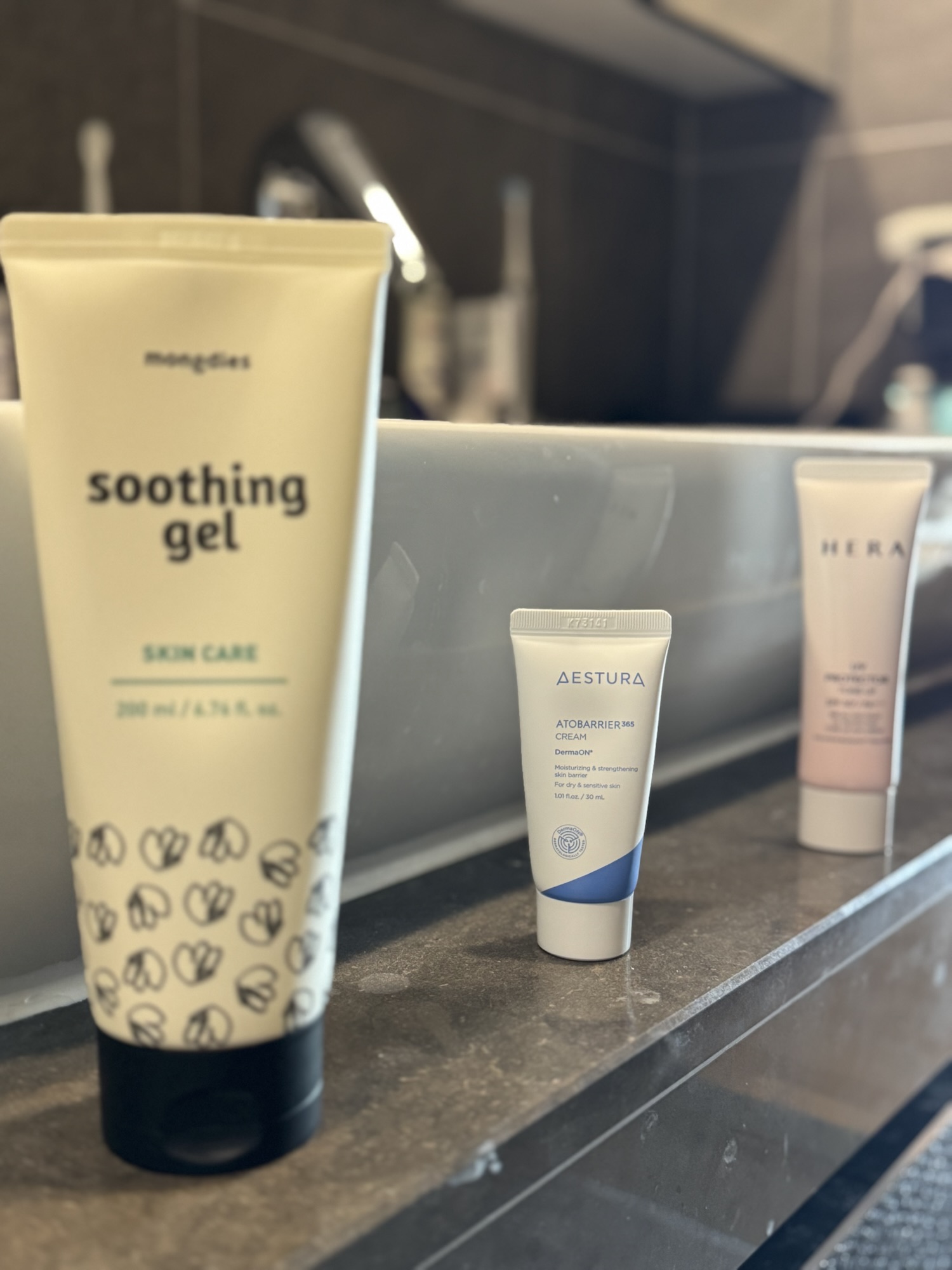
A fast fave: Aestura Atobarrier 365 – now available in the US!
What Sunscreen Actually Works?
Hera UV Protector Tone-Up SPF 50+. I’ve tested probably fifteen sunscreens over the years. This one wins.

Good for my skin: Hera’s Tone-Up Sunscreen
It combines sun protection with a subtle tone-up effect (slight brightening, evens out skin tone). The texture absorbs without that white cast you get from a lot of high-SPF formulas. I wear it every single day, rain or shine, summer or winter.
Morning routine complete: cleanse, moisturize, protect. Under five minutes.
What you do at night matters even more. Here’s why.
How Should You Cleanse and Moisturize at Night?
Evening skincare has one job: undo whatever happened during the day and set up conditions for overnight repair. The cleansing needs to be more thorough than morning. The moisturizing uses layers.
Why Is Nightly Cleansing Non-Negotiable?
Never sleep without washing your face. This is the one rule I would pass down to my daughters if I could only pass down one.
I take a hot shower every night and use a textured skin towel to remove sunscreen residue and whatever environmental gunk accumulated during the day. The Ocean Towel brand body towel has been in my routine for over 20 years. Face and body. I’ve tried imitations; they don’t perform the same. This towel travels with me everywhere. Literally everywhere. Japan, Kazakhstan, California, doesn’t matter. It comes.
What Layering Approach Works for Night Moisturizing?
Night moisturizing uses layers, not one thick product. Think of it like clothing: base layer, then insulation.
1. Base layer: Mongdies Soothing Gel again (yes, the baby product). It functions like a toner here, delivering aloe vera that soaks into skin before heavier products.
2. Seal layer: Either La Prairie Caviar Cream or Aestura Atobarrier365 Cream. The La Prairie is expensive. The Aestura is not. They perform almost identically for this purpose, which tells you something about skincare pricing.
3. Alternative for humid nights: Aestura Spray Moisturizer (120ml, which is unfortunately 20ml over carry-on limits). Delivers both lightness and creaminess at the same time. I gift this to friends constantly, but only when I’m checking a bag.
Do Sheet Masks Actually Do Anything?
Honestly? The same hydration results come from applying generous moisturizer or serum, then pressing a tissue sheet against your face for 10 minutes. Aestura Regederm Serum works well for this. That said, there’s the undeniable convenience of ripping open a pouch and putting on a pre-soaked sheet.
The one exception: long-haul flights. Aircraft cabin humidity drops below 20%, which is brutal. I do double-layer sheet masks multiple times during trans-Pacific flights. It’s the only time I think they’re worth the hassle.
Oh, and semi-permanent makeup on brows and eyelids eliminates nightly makeup removal entirely. That’s 15-20 minutes saved every single day. Compounds into weeks annually.
Skincare products can only do so much. The air you breathe and the water you drink either help them work or cancel them out.
Why Does Air Quality Affect Your Skin?
Air quality directly impacts skin through humidity levels and particulate exposure. I didn’t fully appreciate this until I moved to Seoul, where AQI can swing from 30 to 300 in a single week.
What Should You Actually Monitor?
I have an AQI monitor that tracks four things: CO2, fine dust (PM2.5), formaldehyde, and moisture content. Sounds overkill until you live through a week where Seoul’s AQI hits 300 and your skin starts freaking out despite doing everything else right.
How Do You Manage Indoor Air?
Four tools. Different problems require different interventions.
• Humidifier: Adds moisture when levels drop below 40%
• Dehumidifier: Removes moisture when levels exceed 60%
• HEPA air purifier: Filters particulates during high-AQI days
• Open window: Fresh air exchange when outdoor AQI permits (this is free and people forget about it)
Target range: 40-50% humidity. Below 40% and your skin dries out. Above 60% and you’re inviting mold.
Alternative hack if you have kids: line-drying laundry indoors overnight. Daily wash loads release enough moisture to maintain humidity without a dedicated humidifier. We stumbled onto this by accident.
Water quality is the other environmental factor nobody talks about.
What Role Does Water Quality Play?
Water affects skin two ways: external contact (showers, face washing) and internal hydration (drinking). Korean consumers are obsessed with water filtration. Shower filters are standard in many households here. At first I thought it was excessive. Now I’m a convert.
How Should You Filter Drinking Water?
I have a 3M 3-stage filtration system mounted under the kitchen sink. Separate spout for filtered water. Filter changes twice a year. No professional service needed; I do it myself in about ten minutes.
Is it necessary? Depends on your tap water. But after tasting the difference, I can’t go back.
How Much Water Should You Actually Drink?
2 liters daily. I use a Kinto insulated 300ml cup and just count refills throughout the day. No apps, no complicated tracking. Seven refills and I’m done.
Boring? Yes. Effective? Also yes.
The last factor is the one that’s hardest to control, especially if you have kids.
How Does Sleep Impact Your Glow-Up Results?
Sleep is when your body repairs itself. Bad sleep shows on your face within days. Chronic bad sleep produces effects that no skincare product can fix.
Why Does Continuous Sleep Matter More Than Total Hours?
According to Dr. Dan at SleepWise, continuous sleep blocks matter more than total hours. Four hours of sleep, then waking, then four more hours provides less benefit than six continuous hours. Your body needs uninterrupted time to complete repair cycles.
I know this intimately because I have three kids. A nursing toddler and a five-year-old who visits at 1am will fragment your sleep for years. There’s no hack for this. You just survive it and things slowly improve as they get older.
How Do You Optimize Your Sleep Environment?
Figure out what disrupts you and fix it systematically:
• Light-sensitive: Blackout curtains or eye mask. I use an eye mask that travels with me because hotel curtains are unreliable.
• Sound-sensitive: Earplugs. I also request the quietest room available when booking hotels (away from elevators, ice machines, street noise).
The key is that your adaptation has to travel. Whatever works at home needs to work in hotel rooms, guest rooms, Airbnbs. Otherwise you’re only sleeping well part of the time.
All of this boils down to five rules. These are the ones I’d teach my kids.
What Are the Five Non-Negotiable Habits?
Five practices produce most of the results. Everything else is optimization.
1. Wash Your Face Every Night
I said it before. I’ll say it again. Nothing matters more than removing daily accumulation. Skincare products cannot penetrate through residue from sunscreen, pollution, and oxidized sebum. If you skip washing, you’re wasting whatever you put on afterward.
2. Wear Sunscreen and a Hat Every Day
Sun damage is the main thing that brings my California friends to Korean clinics. They’ve spent decades in sunshine without protection and now they want to undo it.
Here’s the thing: sun damage requires multiple treatment sessions over months or years to address. It is not a one-trip fix. Prevention through daily SPF and a hat costs less money, less time, and less skin stress than correction. Way less.
3. Manage Moisture at Every Level
This operates at three levels and you need all three:
• Topical: Moisturizer weight appropriate for climate
• Environmental: Indoor humidity at 40-50%
• Internal: 2 liters of water daily
Chronic dryness produces that cracked, leathery texture that ages you beyond your actual years. It’s preventable.
4. Use Available Tools and Services
Semi-permanent makeup on brows and eyelids saves 15-20 minutes daily. That’s real time that compounds. Not everyone needs this; people with naturally thick lashes and well-shaped brows (genetic luck) can skip it.
Needle-free jet injections of hyaluronic acid (NIH study on efficacy) deliver instant refreshed appearance. For frequent travelers who need to look rested after landing, this works faster than any topical product.
5. Prioritize Continuous Sleep
Sleep is your body’s repair window. Identify what disrupts yours (light, sound, temperature, children) and address each one systematically. This is boring advice but it’s correct.
FAQ: At-Home Glow-Up Routine
What is an at-home glow-up routine?
An at-home glow-up routine is a daily skincare and wellness practice combining product application, environmental management, and sleep optimization. It delivers clinic-level results without clinic visits.
How long does the routine take?
Morning: under five minutes (cleanse, moisturize, SPF). Evening: 10-15 minutes including shower and layered moisturizing.
Do expensive products work better than cheap ones?
Not necessarily. Mongdies Soothing Gel (mid-range baby product) performs comparably to La Prairie Caviar Cream for specific use cases. Match product to need, not price.
Can at-home routines replace professional treatments?
They maintain and extend professional results. Clinic treatments (lasers, injectables) address issues topical products cannot. But without consistent home care, treatment results degrade faster.
What single change makes the biggest difference?
Never sleeping without washing your face. This prevents the accumulation that causes most preventable skin damage.